Illustration

Personal Avatar
The Personal Avatar Illustration is your first exercise of the semester: a warm-up, but also a chance to build a stylized self-portrait that represents you in this class going forward, not a strict likeness study, but an illustrated version of yourself you're comfortable putting your name on. Where the rest of this project asks for observational accuracy, the Avatar asks the opposite: interpret, simplify, and stylize your own features into a single confident image.
This is a synthesis exercise more than a skill-building one. It doesn't introduce anything new, it asks you to draw on everything you're already bringing into this class: your prior drawing and painting training, your design and color theory foundation, and whatever illustration experience you've picked up on your own. There's no single right look for an Avatar; the goal is a legible, personal visual identity you can recognize as yours and watch develop over the semester.
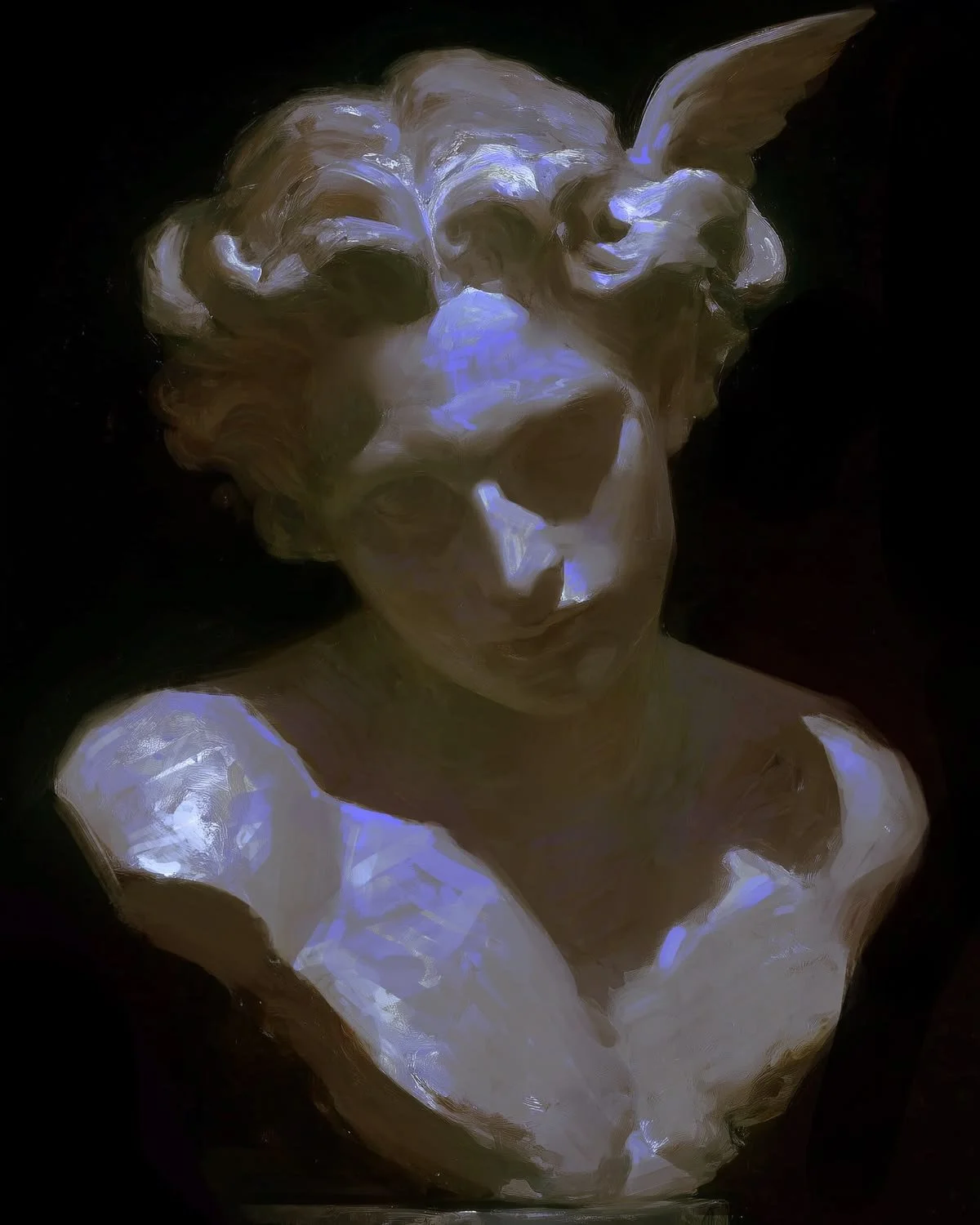
Plaster Cast: Introduction to Painting Process for illustrators
This project opens the illustration sequence by asking students to build the single most important habit of an illustrator's toolkit: the disciplined replication of what is actually seen. Working from a plaster cast in the studio, students will construct a full-color illustration in two stages, first establishing an accurate value structure, then layering in an equally accurate reading of the cast's subtle, observed color, before pushing the resolved study toward a dynamic, expressive illustration of the same static reference.
This is not simply a rendering exercise. A plaster cast is an ideal subject precisely because it removes the variables of a live model (color, texture, movement) and isolates the two skills this project is built to train: seeing value structure on a complex three-dimensional form, and seeing the subtle color information hidden inside what looks, at first glance, like a colorless object. As the first project of your illustration education, it is meant to set the baseline: if you can render a static, neutral form with this level of observational accuracy and stylistic intention, you have the foundation everything else in this course, and this program, will build on.
The project opens with your Personal Avatar Illustration, a self-portrait warm-up you will repeat every illustration class with me to track your own progress and style development. It exists to get you into the studio, working, from day one.

Portraiture: Caricature, Expression, and Likeness
This project moves your illustration practice from replication into interpretation. Where your previous work asked you to observe and record as accurately as possible, this one asks you to use that same observational foundation and then knowingly depart from it: to understand a face well enough that you can choose what to exaggerate, simplify, or omit, and still have the result read as recognizably, convincingly that person. This is where your work starts to move toward narrative: an exaggerated or expressive portrait isn't just a likeness, it's a likeness making an argument about who someone is.
The work centers on two skills that develop together. Likeness is building an understanding of a specific face precise enough that you can construct and manipulate it while it still reads as that individual. Expression is understanding how the underlying structure of a face communicates emotion, attitude, and character, and how pushing that structure past its neutral state changes what a viewer reads into an image. Between them sits the real question you're working through: where and when do you distort a portrait for expressive or narrative effect, and how far can that distortion go before it stops reading as its subject? You'll test that boundary directly, working from both a self-portrait and a portrait of a public figure, pushing each toward exaggeration while staying in control of how much likeness you're willing to trade for impact.