Skeleton
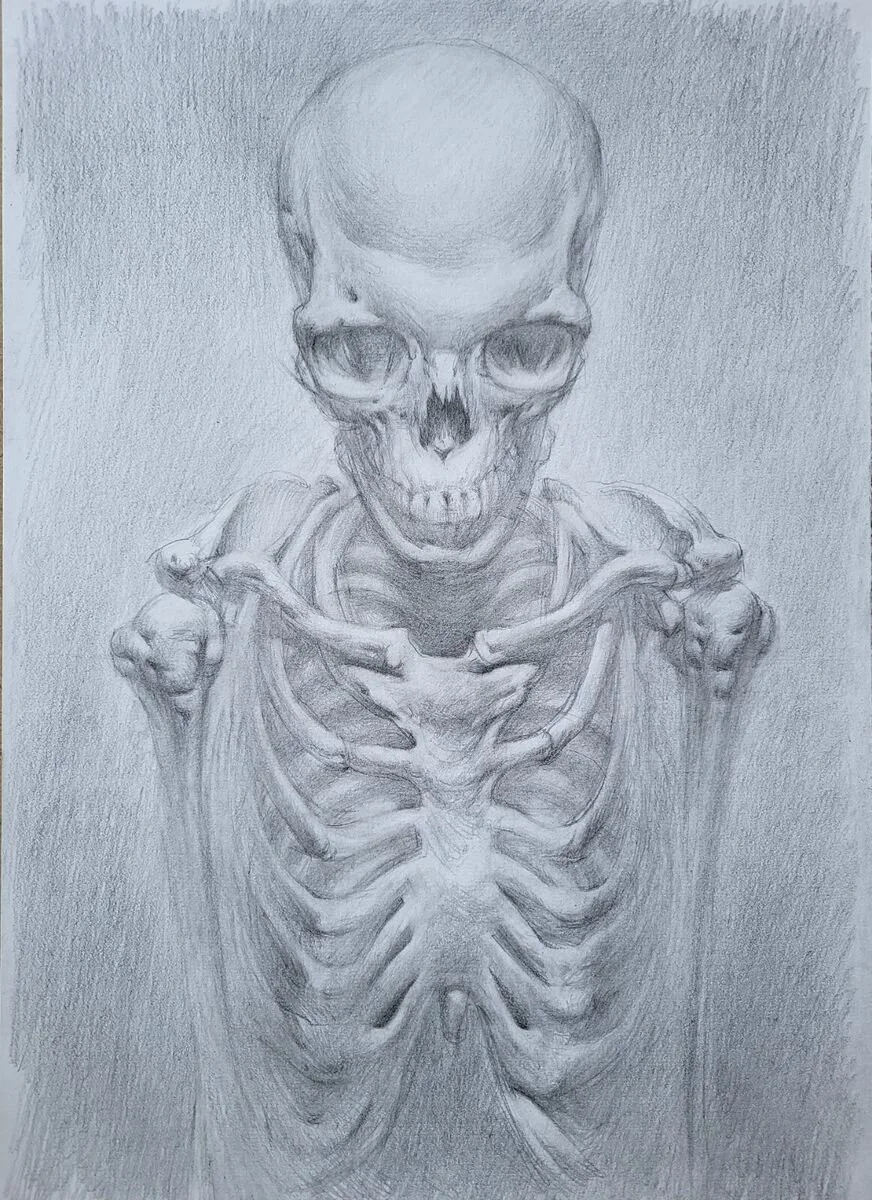
Project Brief
Objective
Drawing the skeleton is foundational to understanding the structure of the human figure. This project will focus on creating an accurate and dynamic study of skeletal anatomy, helping students to master proportion, anatomical landmarks, and figure-ground relationships.
Goals
Present work cleanly and professionally.
Gain a foundational understanding of skeletal anatomy, proportions, and bony landmarks.
Develop compositional strategies with a focus on figures in dynamic environments.
Demonstrate the ability to simplify complex forms while executing a professional, finalized work of art.
Project Outline
Final Project Description:
Create a detailed and dynamic study of the human skeleton drawn from observation. Pose the skeleton in a visually engaging, dynamic stance with thoughtful lighting to create a dramatic and interesting composition. Your drawing should display accurate proportions and measured observation of the skeletal structure. Utilize line weight and value to enhance the visual interest of the piece.
Media:
Graphite or charcoal on artist-quality drawing paper, minimum size 18 x 24 inches. Maintain a ½ to 1-inch border around the composition to avoid drawing off the page or creating unwanted tangents.
Requirements for Final Drawing:
Render at least ¾ of the full skeleton.
Carefully consider figure-ground relationships and background elements to enhance composition.
Apply accurate measuring techniques to ensure proportional accuracy.
Utilize varying line weights and strong value development to emphasize form, light, and shadow.
Present the drawing as a polished, final work of art.
Ideation process
Thumbnails (Minimum of 16) : Create small compositional sketches to explore pose, scale, and layout options. About 3 to 4 minutes each
¼ page Sketches (Minimum of 4) : Chose your 4 best thumbnails to Create 4 refined sketches (approx. 4 x 5 inches) to develop your strongest ideas further. About 15 minutes each
Half-Page Studies (Minimum of 2) : Chose your 2 best sketches and refine them further ;Focus on skeletal form and pose dynamics, incorporating accurate proportions and simplified shapes. About 30 minutes each
Final Drawing : Fully rendered 18 x 24-inch drawing on artist-quality paper. Include accurate proportions, dynamic pose, measured bony landmarks, and a well-composed environment.This should be a fully rendered image utilizing a minima of 5 values clear values representing a clear single light source. This drawing should represent a minimum of 15 hours of drawing time be a refined image that is gallery ready.
Professional Documentation : Photograph or scan the work professionally : Ensure cropped edges, even and consistent lighting, and high-resolution quality.
Skills
Proportional Accuracy : Applying correct human skeletal proportions through careful observation and measurement techniques.
Skeletal Anatomy Knowledge : Understanding and identifying key anatomical landmarks of the skeleton. Knowing the structure and function of the major bones of the human body.
Figure-Ground Relationships : Establishing clear separation between the figure and background through composition, ensuring the skeleton stands out visually.Creating dynamic and engaging compositions with proper use of space and balance.
Dynamic Posing : Posing the skeleton in action, capturing the gesture and movement of the figure. Using thoughtful, visually stimulating stances that reflect the natural and dynamic nature of the human form.
Line Work and Value Development : Using varied line weights to express depth, light, and form. Developing a range of values (minimum of five) to create three-dimensionality and a clear light source.
Simplification of Complex Forms : Breaking down complex anatomical structures into simplified, easy-to-draw forms that still retain accurate proportions and details.
Measured Observation : Applying precise observation skills to capture the exact angles and positions of bones, ensuring accuracy in proportion and scale.
Composition and Lighting : Understanding and manipulating lighting to enhance the mood and atmosphere of the piece. Positioning the light source effectively to cast dramatic shadows and highlight the skeletal structure.
Use of Media : Refining the use of graphite or charcoal for detailed rendering, creating textures, smooth transitions, and strong contrasts. Developing control over media to express form and shadow in a clean, polished manner.
Presentation : Presenting work in a professional manner, ensuring all edges are neat, and the piece is clean and finished to a high standard. Creating a final artwork that is gallery-ready and suitable for display or professional submission.