FIGURE : THE BODY, COMPOSITION AND GESTURE
Projet Brief
In our second project of the semester, we will continue to explore the human figure, shifting our focus from portraiture to the body and gesture as primary elements of expression. While your work may still include aspects of portraiture, the emphasis should be on anatomy, movement, and the figure within an environment. Building on the skills developed in Figure Drawing, this painting should incorporate narrative storytelling through gesture, composition, and setting.
We will further explore color theory by structuring color relationships in the environment based on natural or synthetic lighting, with careful consideration of color temperature and its effects on form and atmosphere. This project will also expand your technical painting experience, incorporating both direct (alla prima) and indirect (layered) painting methods to refine your approach to composition, form, and texture.
Additionally, through ideation and personal research, we will expand the concept of figurative painting beyond traditional depictions of individuals, exploring how cultural ideas and identity can be expressed through the human form in context.
Skills:
This project builds upon previously established skills from figure drawing, portrait painting, and color theory, refining technical and conceptual approaches to painting the human figure in context.
Figurative & Anatomical Skill : Further develop constructive anatomy, reinforcing knowledge of skeletal structure, musculature, and proportion. Strengthen the ability to capture gesture, movement, and dynamic poses within a narrative composition. Improve foreshortening and spatial accuracy when placing the figure in an environment.
Color & Light Application : Expand knowledge of color theory, with a focus on color temperature shifts within the figure and its environment. Explore natural and synthetic lighting conditions, understanding how light sources affect form, value structure, and atmosphere. Develop the ability to harmonize figure and background colors, ensuring a cohesive composition.
Painting Technique & Process : Advance direct (alla prima) and indirect (layered) painting methods to create a balanced interplay of soft and hard edges. Further refine brushwork, mark-making, and textural variety to enhance the expressive quality of the painting. Strengthen paint handling and blending techniques for smooth transitions and controlled edges. Improve underpainting and glazing techniques to build depth and luminosity in skin tones and environments.
Composition & Conceptual Development : Develop strong compositional strategies, integrating the figure into a background that supports the narrative. Explore storytelling through pose, gesture, and environmental context, making intentional choices in design and framing. Reinforce the ability to lead the viewer’s eye through composition using contrast, rhythm, and focal points. Expand personal voice and conceptual depth, using figurative painting as a means of communication beyond literal representation.
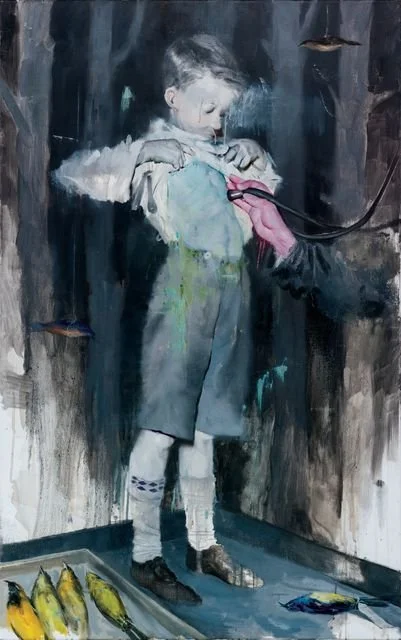
Justin Mortimer
Gesture in contemporary painting serves as a dynamic force, capturing both the movement of the figure and the expressive energy of the artist’s mark-making. The physicality of the body—whether subtle or extreme—conveys tension, rhythm, and emotion, transforming the figure into a vehicle for storytelling. Through exaggeration, distortion, or fluidity of form, gesture enhances narrative depth, allowing for the expression of psychological and emotional states beyond mere representation.
Beyond the figure itself, the painter’s brushwork and mark-making contribute to the vitality of the composition. Loose, gestural strokes can evoke immediacy and raw emotion, while controlled, intentional marks can suggest precision and restraint. The interplay of thick impasto, delicate glazes, and broken edges allows for a dynamic conversation between subject and surface. Gesture in painting, then, is not only about capturing movement within the figure but also about the energy and presence of the artist’s hand, reinforcing the emotional and physical impact of the work.
Gesture has long been a fundamental tool in theater and cinema, serving as a universal language that communicates emotion, intent, and narrative beyond spoken words. In theater, movement is often exaggerated to ensure clarity and visibility for the audience, with actors using body language, posture, and expressive gestures to convey internal states and dramatic tension. Classical traditions, such as Japanese Noh and Kabuki theater, emphasize codified gestures that symbolize specific emotions, while contemporary stage performance integrates naturalistic movement with choreographed physicality to enhance storytelling.
Cinema, with its ability to control framing, lighting, and perspective, uses gesture more subtly yet no less powerfully. Directors like Ingmar Bergman and Andrei Tarkovsky masterfully employed small, restrained gestures—such as a fleeting glance or a tense grip of the hands—to build psychological depth. In contrast, filmmakers like F.W. Murnau and the German Expressionists emphasized bold, exaggerated physicality, using gesture to create highly stylized, emotionally charged performances. In contemporary cinema, directors like David Lynch manipulate gesture through slowed movement, repetition, and framing to evoke dreamlike atmospheres and psychological unease. Whether theatrical or cinematic, gesture is a critical storytelling device, allowing actors to externalize inner conflicts, convey subtext, and enrich visual composition in ways that transcend dialogue.
Painting ideation process :
Work toward our final illustration, you will be expected to utilize an extensive, rigorous and professionally organized ideation process. This process will include
A page of 1⁄4 page sketches, . ( 15 minutes each) :composed in boxes representing the proportion and structure of your composition. 2 to 3 values this is about Gestalt and Notan
2 Color studies. (30 minutes each) these may be done utilizing Adobe illustrator. Graphics representation of your images that explore color theory. ( illustrator allows you to test our color fast once you have created the design)
Full tonal Pencil/ charcoal Drawing. Drawing dune to scale of final composition as a guide for
Refinement of Anatomical Understanding : Deepen knowledge of full-body anatomy, emphasizing gesture, proportion, and structure. Strengthen understanding of muscle groups and skeletal landmarks to enhance figure construction. Explore how movement and weight distribution affect the figure dynamically in space.
Advanced Color Theory Application : Utilize color harmonies (complementary, analogous, split-complementary, etc.) to unify compositions. Apply color temperature shifts to create depth and atmosphere within a scene. Develop sensitivity to chromatic neutrals, balancing hue, value, and chroma for expressive color palettes.
Observation and Perception : Hone observational skills in capturing gesture, rhythm, and energy in the figure. : Study the effects of natural and artificial lighting on form and composition. Translate three-dimensional structures into compelling two-dimensional interpretations with accuracy.
Gesture and Expressive Mark-Making : Use gestural brushwork to convey movement, tension, and emotion in both the figure and environment. Balance areas of refined detail with loose, expressive passages to create visual contrast. Explore the interaction between direct mark-making and indirect layering to enhance expression.
Conceptual Thinking and Narrative Development : Develop a visual narrative through gesture, body language, and environmental cues. Explore the psychological and symbolic aspects of the figure beyond representational likeness. Engage with broader cultural or thematic ideas to add depth to the storytelling in the work.
Painting Construction and Technique : Refine both direct (alla prima) and indirect (layered) painting methods for technical control. Experiment with edge control and value hierarchy to direct focus and create depth. Utilize texture and opacity variations to add richness and dimension to the painting surface.
Advanced Composition and Design : Apply principles of balance, rhythm, and focal point to strengthen composition. Use preliminary studies (thumbnails, color studies, and value sketches) to refine compositional ideas. Explore dynamic asymmetries and spatial relationships to create compelling arrangements.
Professional Presentation : Develop a polished and professional finish, considering framing, mounting, or alternative installation methods. Ensure all work, including preliminary studies, demonstrates care and craftsmanship. Consider how display choices impact the viewer’s engagement with the piece.
Time Management and Iterative Process : Establish a structured workflow, from ideation and sketching to final execution. Refine concepts through multiple iterations, allowing room for adaptation and growth. Integrate supporting works, such as preparatory drawings or smaller studies, into the gallery presentation.
Refined Reference Creation: Lighting and Environment : Construct and control lighting setups to enhance form, mood, and storytelling. Integrate reference materials from interdisciplinary practices—sculpture, photography, or mural work—to enrich the painting. Experiment with projection, digital manipulation, or mixed-media elements to expand environmental depth.
Personal Artistic Voice : Engage in self-directed research to deepen thematic and conceptual development. Experiment with stylistic elements—shape design, color palettes, edge work, and brush handling—to refine artistic identity. Develop a cohesive body of work that reflects individual artistic interests and creative vision.