Cast Drawing : Value & Form Logic
Project Brief
Objective
This project introduces students to the atelier tradition of cast drawing through sustained, deliberate observation. Working from a single plaster cast under a consistent, controlled light source, students will study how light describes form and how complex surfaces can be understood through proportion, plane changes, and value relationships. The emphasis is placed on accuracy, patience, and visual discipline, rather than speed or expressive interpretation.
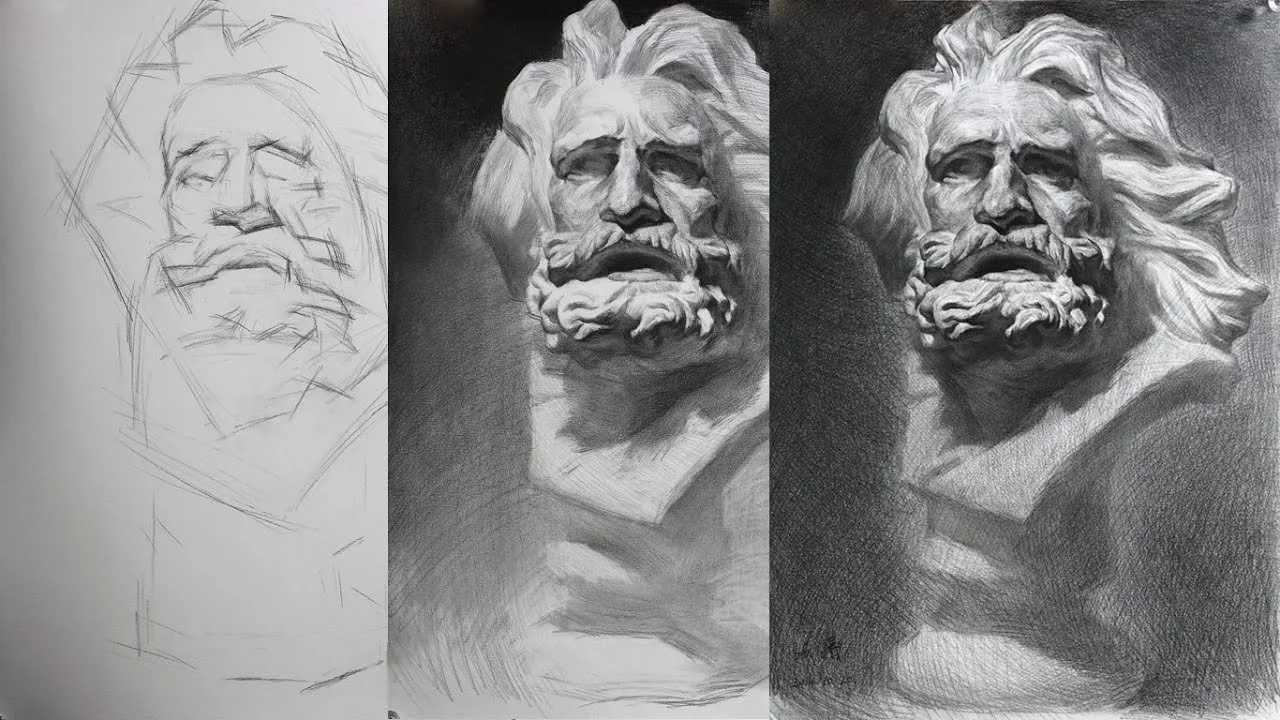
Over the course of three weeks, students will complete one resolved cast drawing using straight-line construction, careful measurement, and a structured rendering methodology informed by the Charles Bargue drawing system. The process moves deliberately from establishing accurate proportions and angles, to organizing clear light and shadow masses, and finally to refining form through controlled value transitions and edges. Each phase builds directly on the previous one and should not be rushed.
Although the subject remains fixed, the project begins with an iterative sketchbook phase. Students will analyze the cast through multiple small studies before committing to the final drawing. This preparatory work reinforces that strong drawings are the result of planning, comparison, and sustained looking, not trial-and-error rendering. The sketchbook studies function as visual problem-solving rather than preliminary sketches.
This is a long-duration, focused observational study, designed to slow the drawing process down and retrain how students see. It is not a sketching assignment, nor is it concerned with stylistic interpretation or personal expression. Instead, it establishes a shared methodological foundation that will support subsequent portrait and figure work throughout the course.
Project Outline
Final Project Description
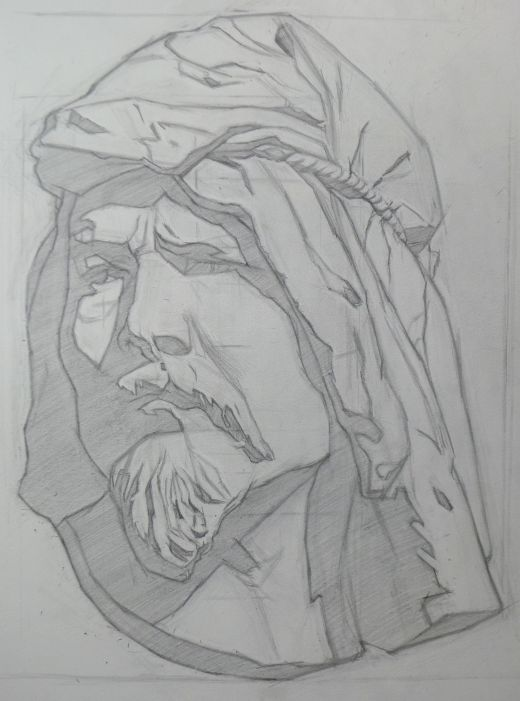
Create a sustained, highly observed drawing of a single plaster cast drawn directly from observation. Using a controlled, single light source, carefully study the cast to understand how light describes form through value, edge, and plane changes. This project emphasizes straight-line construction, accurate proportion, and organized rendering, following a disciplined, atelier-informed methodology.
The drawing should demonstrate a clear progression from structural layout to refined value relationships, showing deliberate decision-making at each stage of the process. Students are expected to work slowly and intentionally, prioritizing accuracy, clarity, and form over expressive mark-making or stylistic interpretation.
Media
Graphite or charcoal on artist-quality drawing paper
Minimum size: 18 x 24 inches
Maintain a ½–1 inch border around the composition to avoid drawing off the page or creating unwanted tangents.
further ;Focus on skeletal form and pose dynamics, incorporating accurate proportions and simplified shapes. About 30 minutes each
Requirements for Final Drawing:
Draw one plaster cast (head or fragment) from the classroom collection
Work from direct observation
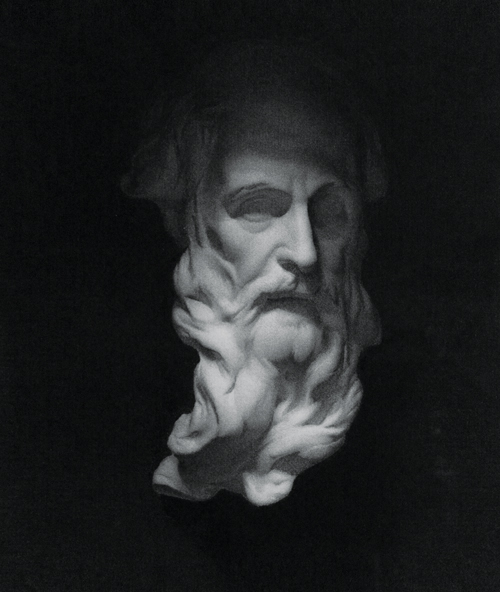
Use a single, consistent light source for the entire duration of the project
Establish accurate proportions using straight-line construction and measured observation
Clearly organize the drawing into light and shadow value masses before refinement
Develop form through controlled value transitions and edge variation
Avoid s stylization, or expressive exaggeration
Present the drawing as a resolved, polished observational study
Ideation process
Thumbnails (Minimum of 16) : Create small compositional sketches to explore, scale, and layout options. About 3 to 4 minutes each
¼ page Sketches (Minimum of 4) : Chose your 4 best thumbnails to Create 4 refined sketches (approx. 4 x 5 inches) to develop your strongest ideas further. About 15 minutes each
Half-Page Studies (Minimum of 2) : Chose your 2 best sketches and refine them further ;Focus on skeletal form and pose dynamics, incorporating accurate proportions and simplified shapes. About 30 minutes each
Final Drawing : Fully rendered 18 x 24-inch drawing on artist-quality paper. Include accurate proportions, dynamic pose, measured bony landmarks, and a well-composed environment.This should be a fully rendered image utilizing a minima of 5 values clear values representing a clear single light source. This drawing should represent a minimum of 15 hours of drawing time be a refined image that is gallery ready.
Professional Documentation : Photograph or scan the work professionally : Ensure cropped edges, even and consistent lighting, and high-resolution quality. Do not forget to document your work throughout the process and each millstone, including line drawing, 2
Week-by-Week Breakdown
Week 1: Ideation & Structural Layout
Complete all sketchbook requirements
Select the most accurate and well-organized study
Begin the final drawing with:
Straight-line block-in
Proportional verification
Angle and landmark checks
No shading beyond very light mapping
Primary focus:
Structure, proportion, and observation accuracy
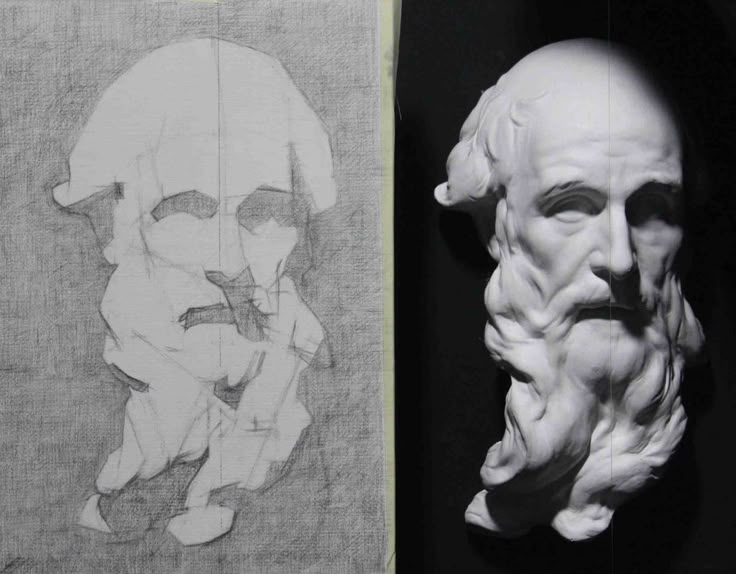
Week 2: Refinement & Two-Value Organization
Refine the block-in while maintaining straight-line logic
Establish a clear two-value separation:
Light mass
Shadow mass
No midtones yet
Shadows should be:
Unified
Flat
Clearly separated from light
Primary focus:
Value organization and form clarity
Week 3: Rendering & Edge Transitions
Gradual rendering from large to small
Develop:
Subtle value shifts within light and shadow
Plane changes
Edge hierarchy (hard, soft, lost)
Maintain consistent light logic throughout
Primary focus:
Controlled rendering, form modeling, and edge transitions
Lighting & Setup Requirements
Use one plaster cast for the entire project
Work under one consistent light source with no changes to angle or intensity
Maintain a consistent drawing setup throughout the project
Mark the location of your easel and standing position on the floor
Use artist tape or blue painter’s tape to indicate placement
Ensure the tape is removed at the end of each session
Do not trace or use photo reference
Consistency of lighting and setup is essential for accurately understanding and rendering form through light. Even small shifts in viewpoint or light position can significantly alter value relationships and undermine the observational goals of the project.
Time Expectation
Students should expect to spend approximately 15–20 total hours over three weeks, divided into sustained working sessions.
This project is intentionally deliberately and methodical.
Skills
Physical / Formal Skills
Proportional Accuracy
Applying accurate proportional relationships through careful observation and measurement, ensuring the cast is drawn at the correct scale and with consistent spatial relationships.
Straight-Line Construction & Structural Clarity
Using straight-line block-in methods to establish clear structural organization, accurate angles, and well-defined form before rendering.
Value Organization & Light Logic
Developing a clear and controlled value structure that accurately reflects a single, consistent light source, including a strong separation between light and shadow.
Edge Control & Form Transitions
Using varied edge quality—hard, soft, and lost edges—to describe form, depth, and plane changes in a controlled and intentional manner.
Figure–Ground Relationships
Establishing a clear visual separation between the cast and the background, using value and composition to ensure the form reads clearly in space.
Media Handling
Refining control of graphite or charcoal to produce clean, deliberate marks, smooth value transitions, and convincing three-dimensional form without overworking the surface.
Conceptual Skills
Measured Observation
Applying precise observational strategies, including comparative measurement and angle checking, to translate three-dimensional form accurately onto a two-dimensional surface.
Simplification of Complex Forms
Breaking down complex forms into simplified planes and masses while maintaining structural integrity and proportional accuracy.
Form Through Light
Understanding how light describes form, volume, and plane changes independent of narrative, expression, or surface detail.
Process-Driven Drawing Methodology
Engaging in a structured, sequential drawing process—analysis, block-in, value organization, and rendering—rooted in classical drawing practice.
Personal Engagement & Professional Practice
Sustained Focus & Patience
Developing the ability to work deliberately over extended periods, maintaining attention and consistency throughout a long-duration observational study.
Critical Self-Assessment
Evaluating accuracy and clarity at each stage of the process and making informed adjustments rather than relying on instinct or guesswork.
Professional Presentation
Presenting work cleanly and professionally, with attention to edges, surface quality, and overall finish appropriate for critique, portfolio use, or exhibition.
Documentation
Photographing or scanning completed work with care, ensuring even lighting, accurate color and value representation, proper cropping, and clear presentation.