Project Brief
This project marks the transition from foundational figure study and introductory illustration projects into applied narrative illustration, translating the drawing skills built across the prior figure drawing and illustration class sequence into a single, fully resolved image designed to communicate a story within the conventions of a card format: Tarot & Oracle cards, trading cards, playing cards, Trading Card Game (TCG) systems, or greeting and holiday cards. Students will work freely between traditional and digital tools, building on their introductory work as they move into a digital illustration class, treating media as a set of options chosen for the image rather than a fixed pipeline.
The emphasis is on composing an image that reads clearly and powerfully both at full working scale and at the reduced scale a card format demands, a discipline distinct from, and in addition to, the narrative framing developed in previous work.
Final Project Description
Create a single, fully resolved narrative illustration composed to function as a card: Tarot & Oracle cards, trading cards, playing cards, Trading Card Game (TCG) systems, or greeting and holiday cards; any of these formats is acceptable. Choose a pose, lighting scheme, and environment that reinforce the story you are exploring, and use atmospheric perspective to establish clear spatial depth between the figure and its surroundings.
The image should be legible as a strong, iconic read even when viewed small. Consider silhouette, value contrast, and focal hierarchy in addition to the framing and shape-language principles carried forward from previous projects. Media is open, but the process should include a step into digital tools: a common approach is to begin in a medium you're already comfortable with, then transition into digital for color development and the editability digital tools allow. Software and physical materials should be chosen for what best serves the image at each stage, not required to be uniform across the class.
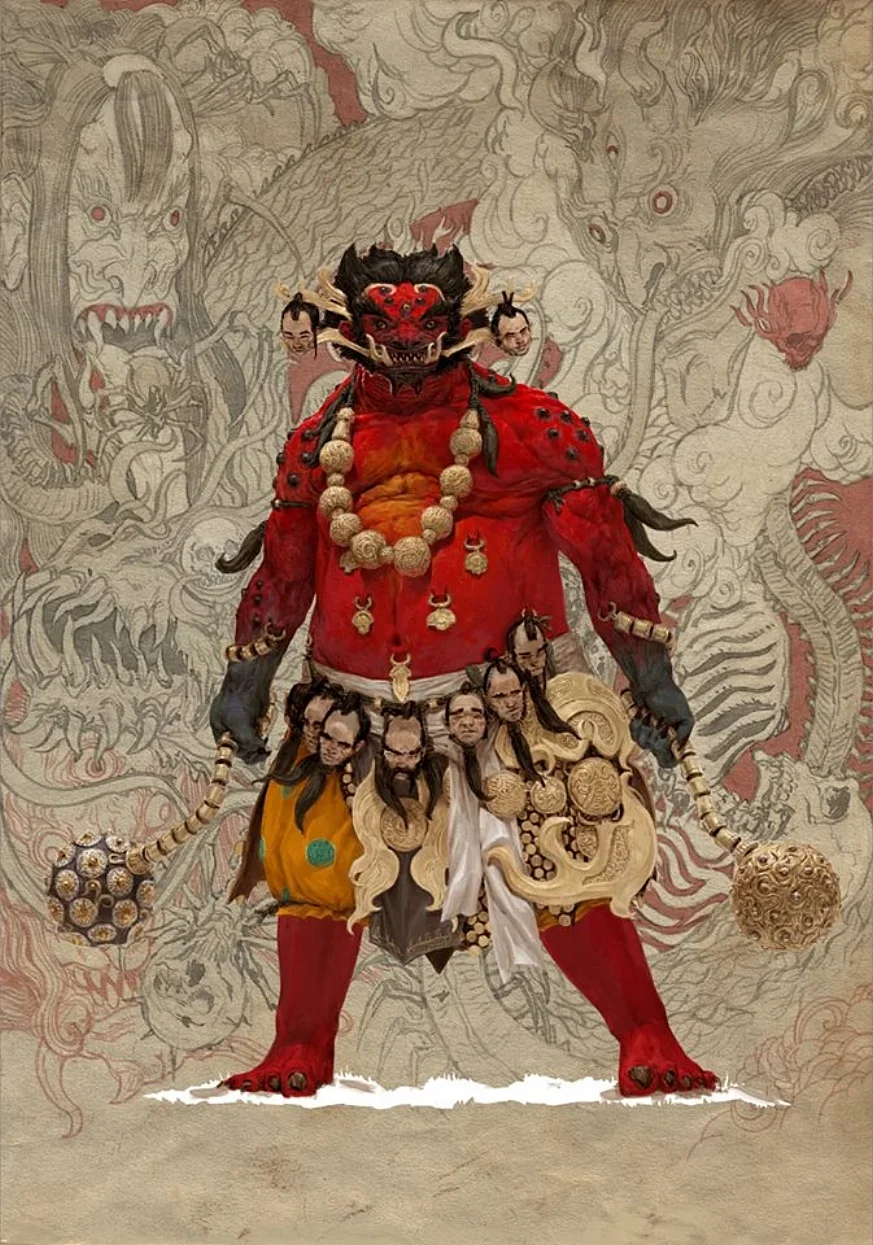
Adrian Smith
Rising Sun
Portfolio Note:
While its importing to have a diverse portfolio showcasing a wide range of skills and technical abilities. You may also want to demonstrate the ability to work through a cohesive body of work with consistent design language, and themes. For this purpose I whirl suggest that you may want to chose an over arching “world” that you are design and Illustrating through out the semester, Perhaps 3 or even all four of the project we complete over the course of the semester develop and refine the world.
Illustration iteration and ideation process :
Work toward our final illustration, you will be expected to utilize an extensive, rigorous and professionally organized ideation process. This process will include
A page of 16 Thumbnaisl or “silhouettes“ (3to 4 minute mini sketches)
A page of ¼ page sketches, . ( 15 minutes each) :composed in boxes representing the proportion and structure of your composition. 2 to 3 values this is about Gestalt and Notan
2 Color studies. (30 minutes each) these may be done utilizing Adobe illustrator. Graphics representation of your images that explore color theory. ( illustrator allows you to test our color fast once you have created the design)
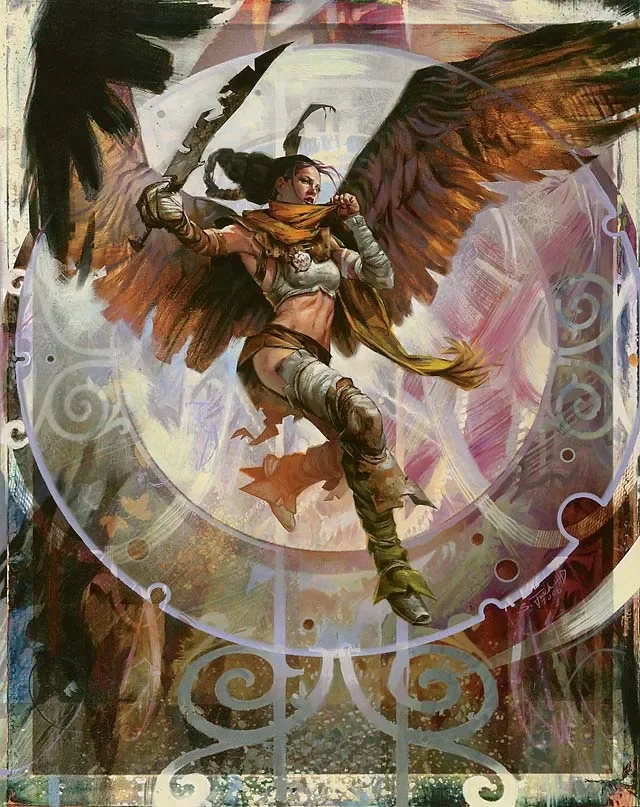
Serra Avenger art by Scott M. Fischer
Goals
Present work cleanly and professionally, in whatever medium or combination of media is used.
Apply narrative framing and staging (close-up, mid-range, establishing) developed in prior figure work to a single card-format composition.
Introduce atmospheric perspective as a tool for describing depth, distance, and mood in the environment.
Work fluidly between traditional and digital tools, choosing media intentionally rather than defaulting to a single pipeline.
Design a composition that stays legible and iconic when reduced to card scale, not only at full working size.
Continue to strengthen figure accuracy, anatomy, proportion, shape design, and color theory through the parallel figure-study track.
Materials & Media:
No prescribed medium: traditional, digital, or a considered mix, chosen intentionally for the image, not by default.
If working digitally: final file at minimum 300 dpi at final print size, delivered as a flattened image (PNG, JPG, or TIFF) alongside the working file.
If working traditionally: final piece scanned or photographed to professional documentation standards (even lighting, cropped, high resolution).
Reference proportions for common card formats: standard trading card approximately 2.5 × 3.5 in (750 × 1050 px at 300 dpi); tarot approximately 2.75 × 4.75 in (825 × 1425 px at 300 dpi). Adapt to the proportions of your chosen card type.
Maintain a clean, intentional border or margin appropriate to the chosen card format.